The Art of Noise Luigi Russolo Chicago Style Citation

Encompass of Luigi Russolo'due south Fifty'arte dei rumori, published in volume form in 1916
The Fine art of Noises (Italian: L'arte dei Rumori) is a Futurist manifesto written past Luigi Russolo in a 1913 letter to friend and Futurist composer Francesco Balilla Pratella. In it, Russolo argues that the human ear has go accustomed to the speed, free energy, and noise of the urban industrial soundscape; furthermore, this new sonic palette requires a new approach to musical instrumentation and composition. He proposes a number of conclusions about how electronics and other technology will allow futurist musicians to "substitute for the limited diversity of timbres that the orchestra possesses today the space diversity of timbres in noises, reproduced with advisable mechanisms".[1]
The Art of Noises is considered by some authors to be one of the most important and influential texts in 20th-century musical aesthetics.[ii]

Intonarumori instruments congenital by Russolo and Ugo Piatti, photograph published in Russolo'due south 1913 book The Art of Noises
The development of audio [edit]
Russolo's essay explores the origins of man made sounds.
Ancient life was all silence [edit]
Russolo states that "noise" kickoff came into existence as the issue of 19th century machines. Before this time the earth was a tranquillity, if not silent, place. With the exception of storms, waterfalls, and tectonic activity, the noise that did punctuate this silence were not loud, prolonged, or varied.
Early sounds [edit]
He notes that the primeval "music" was very simplistic and was created with very elementary instruments, and that many early civilizations considered the secrets of music sacred and reserved it for rites and rituals. The Greek musical theory was based on the tetrachord mathematics of Pythagoras, which did not allow for any harmonies. Developments and modifications to the Greek musical arrangement were made during the Middle Ages, which led to music like Gregorian dirge. Russolo notes that during this time sounds were all the same narrowly seen as "unfolding in time."[iii] The chord did not even so exist.
The complete sound [edit]
Russolo refers to the chord as the "complete sound,"[3] the formulation of diverse parts that brand and are subordinate to the whole. He notes that chords developed gradually, offset moving from the "consonant triad to the consistent and complicated dissonances that characterize gimmicky music."[3] He notes that while early music tried to create sweet and pure sounds, it progressively grew more than and more complex, with musicians seeking to create new and more than anomalous chords. This, he says, comes ever closer to the "dissonance-audio" typical of racket music.[3]
Musical noise [edit]
Russolo compares the evolution of music to the multiplication of mechanism, pointing out that our once desolate sound environment has become increasingly filled with the noise of machines, encouraging musicians to create a more "complicated polyphony"[three] in gild to provoke emotion and stir our sensibilities. He notes that music has been developing towards a more than complicated polyphony past seeking greater variety in timbres and tone colors.
Noise-Sounds [edit]
Russolo explains how "musical sound is too limited in its variety of timbres."[3] He breaks the timbres of an orchestra down into four basic categories: bowed instruments, metal winds, wood winds, and percussion. He says that we must "break out of this limited circle of sound and conquer the infinite diversity of racket-sounds,"[3] and that engineering would allow us to manipulate noises in means that could not have been done with earlier instruments.
Time to come sounds [edit]
Russolo claims that music has reached a point that no longer has the power to excite or inspire. Fifty-fifty when it is new, he argues, information technology still sounds one-time and familiar, leaving the audience "waiting for the extraordinary sensation that never comes."[4] He urges musicians to explore the city with "ears more sensitive than eyes,"[iv] listening to the wide array of noises that are frequently taken for granted, even so (potentially) musical in nature. He feels this racket music tin be given pitch and "regulated harmonically," while still preserving irregularity and character, even if it requires assigning multiple pitches to certain noises.
The variety of noises is infinite. If today, when nosotros have perhaps a thousand unlike machines, we can distinguish a thousand unlike noises, tomorrow, equally new machines multiply, we will exist able to distinguish x, twenty, or thirty thousand dissimilar noises, not merely in a but imitative manner, but to combine them co-ordinate to our imagination. [v]
Six Families of Noises for the Futurist Orchestra [edit]
Russolo sees the futurist orchestra drawing its sounds from "six families of noise":[6]
- Roars, Thunderings, Explosions, Hissing roars, Bangs, Booms
- Whistling, Hissing, Puffing
- Whispers, Murmurs, Mumbling, Muttering, Gurgling
- Screeching, Creaking, Rustling, Buzzing,[vii] Crackling, Scraping [seven]
- Noises obtained past chirapsia on metals, woods, skins, stones, pottery, etc.
- Voices of animals and people, Shouts, Screams, Shrieks, Wails, Hoots, Howls, Death rattles, Sobs
Russolo asserts that these are the most basic and fundamental noises, and that all other noises are merely associations and combinations of these. He built a family of instruments, the Intonarumori, to imitate these 6 kinds of noises.[8]
Conclusions [edit]
Russolo includes a list of conclusions:
- Futurist composers should use their creativity and innovation to "overstate and enrich the field of sound"[6] by budgeted the "dissonance-sound."
- Futurist musicians should strive to replicate the space timbres in noises.
- Futurist musicians should gratis themselves from the traditional and seek to explore the diverse rhythms of dissonance.
- The complex tonalities of noise can be accomplished by creating instruments that replicate that complication.
- The creation of instruments that replicate noise should not be a difficult job, since the manipulation of pitch will be simple once the mechanical principles that create the noise have been recreated. Pitch can exist manipulated through simple changes in speed or tension.
- The new orchestra will not evoke new and novel emotions by imitating the noises of life, but by finding new and unique combinations of timbres and rhythms in noise, to find a way to fully express the rhythm and sound that stretches across normal un-inebriated comprehension.
- The variety of racket is infinite, and every bit man creates new machines the number of noises he tin differentiate between continues to grow.
- Therefore, he invites all talented musicians to pay attending to noises and their complexity, and one time they discover the broadness of noise's palette of timbres, they will develop a passion for dissonance. He predicts that our "multiplied sensibility, having been conquered by futurist eyes, will finally have some futurist ears, and . . . every workshop will become an intoxicating orchestra of noise."[iv]
Gallery of Works [edit]
-

education-schema for edifice an Intonarumori racket-machine
-
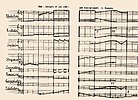
Russolo, 1913: score of en-harmonic annotation; partitura for Intonarumori
Musicians/Artists influenced by The Art of Noises [edit]
- John Muzzle[9]
- Pierre Schaeffer[two]
- Pierre Henry[2]
- Art of Noise[10]
- Adam Ant[eleven]
- Einstürzende Neubauten[2]
- Exam Dept[two]
- Joseph Nechvatal[12]
- DJ Spooky[two]
- Dywane Thomas, Jr.[13]
- Francisco López[2]
- R. Henry Nigl[14]
- Cloth[15]
- Luciano Berio and Bruno Maderna[xvi]
Run into likewise [edit]
- Intonarumori
- Experimental music
- Experimental instrument
- Musica Futurista: The Art of Noises
- Noise music
Bibliography [edit]
- Russolo, Luigi: L'Fine art des bruits. Textes réunis et préfacés par Giovanni Lista, bibliographie établie par Giovanni Lista. L'Age d'Homme, Lausanne, 1975.
- Chessa, Luciano: Luigi Russolo, Futurist: Racket, Visual Arts, and the Occult. University of California Press, 2012.
- Lista, Giovanni: Luigi Russolo e la musica futurista. Mudima, Milan, 2009. ISBN 978-88-96817-00-1
- Lista, Giovanni: Periodical des Futurismes. Éditions Hazan, Paris, 2008.
- Lista, Giovanni: Le Futurisme: Création et advanced. Éditions Fifty'Amateur, Paris, 2001.
External links [edit]
- The Fine art of Noises at the Wayback Auto (archived March 5, 2010)
- The Art of Noises - unknown.nu
- Jessica Palmieri, The Art of Noises (manifesto excerpts), Luigi Russolo eleven March 1913, Futurist manifestos, italianfuturism.org
- [1] Corale, Serenata by Antonio Russolo and Luigi Russolo (1924) were published on cassette in 1988 in the Audio By Visual Artists edition of Tellus Audio Cassette Magazine #21 and are archived on the cyberspace at Ubuweb
References [edit]
- ^ Warner, Daniel; Cox, CChristoph (2004). Sound Culture: Readings in Modern Music. London: Continiuum International Publishing Group LTD. pp. ten–14. ISBN0-8264-1615-2.
- ^ a b c d east f g (Warner & Cox 2004, p. 10)
- ^ a b c d e f thou (Warner & Cox 2004, p. 11)
- ^ a b c Warner & Cox 2004, p. 12
- ^ a b Luigi Russolo (1916). "The Art of Noises (English translation)". Archived from the original on 2010-11-27. Retrieved 2010-eleven-27 .
- ^ a b Warner & Cox 2004, p. 13
- ^ a b The original Italian ronzii and crepitii are most easily translated with humming and rubbing respectively, but the connotations these words have in the English language practise non fit well with the other sounds in this group; for this reason, culling translations give more fitting buzzing and scraping.[5]
- ^ "Intonarumori". 21 February 2004.
- ^ "Media Fine art Net | Source Text". www.medienkunstnetz.de . Retrieved 2016-09-18 .
- ^ Morley, Paul (2002-07-26). "Techno: the early on years". The Guardian . Retrieved 2008-01-13 .
- ^ "Emmet Influences". Auto Trouble . Retrieved 2008-01-thirteen .
- ^ "Noise Venice Biennale Collateral Events" May 27, 2013
- ^ "MonoNeon Bassist, Composer" gruvgear.com.
- ^ "Shout Art".
- ^ "Textile - Intonarumori" at Discogs. Retrieved 2008-01-14.
- ^ "Centro Studi Luciano Berio". Ritratto di città - Studio per una rappresentazione radiofonica.
holguinwifiest1941.blogspot.com
Source: https://en.wikipedia.org/wiki/The_Art_of_Noises
0 Response to "The Art of Noise Luigi Russolo Chicago Style Citation"
Post a Comment